Why I Kept Missing My Goodreads Reading Goals
Since joining Goodreads, I’ve set a reading goal every year through the Goodreads reading challenge—sometimes meeting it, sometimes falling short. And for a long time, I pretended the years I didn’t really count.
Over time, those missed goals added up into what I now call my Goodreads Debt. Starting in 2026, I’m paying that debt back intentionally over three years.
Looking Back at Twelve Years of Challenges
I joined Goodreads as soon as it was “cool” to do so. I have books on my To Read shelf dated as far back as 2009. Back then, I knew nothing about curating my reads to suit my actual preferences. If I found a book I was even remotely interested in, onto my TBR it went. (I’ll be writing more later about how I curate my TBR now—because this is very much a learned skill.)
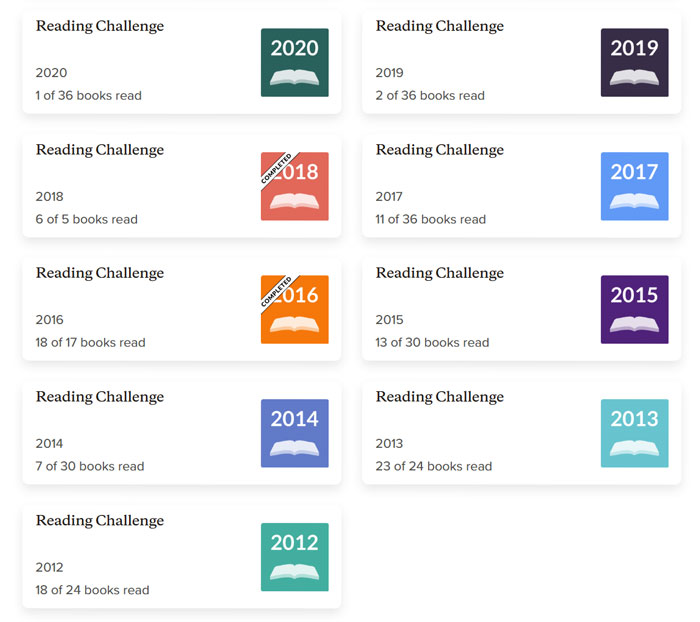
While reading challenges were introduced in 2011, it looks like I didn’t jump onboard until 2012. I’ve technically “participated” in the Goodreads reading challenge every year since. Every year I set a goal—sometimes lofty, sometimes modest—and more often than I’d like to admit, I didn’t meet it.
When My “Missed” Goals Added Up
While working on my plans for reading, work, school, and life for 2026—and choosing my One Little Word, Intention—I decided to look back at my previous reading challenges.
Oh boy, was that the wrong move.
I wanted to abort mission the second I realized I’ve only ever completed the Goodreads Reading Challenge four times. (Not including 2025, which I finished back in November.)
There were several years where I came just shy of completing my goal, and others where… honestly, I might as well have skipped the challenge entirely or set my goal to two books for the year. (Hello, 2019.)
As I stared at the numbers, something interesting emerged. In recent years, I’ve consistently been reading about the same number of books I used to set as my goal. That number? Thirty-six.
Thirty-six books seems to be my real average—the one I can maintain even with a full course load, multiple editing projects, reading commitments, and general life chaos.
And then an idea came to me. What if I took all the challenges I didn’t complete and used the total number of books I “missed” over the last twelve years as my reading goal for 2026?
Joke’s on me. That number was 155 books.
Which is… well over the 96 books I once thought I could read in a year before promptly overwhelming myself. So, no. That was not going to work.
How I Built My Goodreads Debt System
Okay, okay… let’s recalibrate here. There has to be a way to complete the books I didn’t read. What if I spread this “debt” out over three years? What if I set a reasonable goal, based on my debt, and anything that I read over that challenge amount came off of my total debt. BINGO! Well, if I’m going to count overages, let’s go back and look and see if I have any overages from the challenges I’ve completed in the past. Ha! Joke’s on me, as I used to (I’m not going to anymore) update my challenge as I reached it. If I reached the set goal amount in September, I’d bump it another 10-20 books for the end of the year. Well, there went that overage! Either way, I ended up with nine additional books from the past that then came off my initial debt.
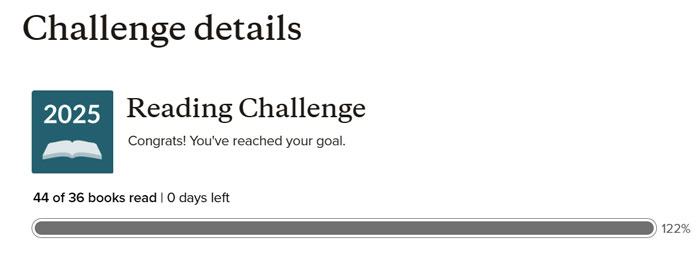
Alright, that’s still high, but not terrible. Then I figured, you know what, let’s see how many books I actually end up reading this year… and then I’ll set the final numbers. My goal was set to 36. I now had a reason not to change/bump my goal total, so I could use the overage to chip away at my book debt. Well, I only went and read an additional eight books in 2025, making the true debt number that I’ll be taking into 2026 as 138 books.
The Math (Without the Shame)
Which brings me to the final step: division.
I took my remaining debt—138 books—and spread it across three years. That gives me a reading goal of 46 books for 2026.
Forty-six.
That’s two more books than I read this year. In a year I’d consider “slow.” That realization stopped me in my tracks.
This year wasn’t slow because I wasn’t reading—it was slow because life was busy, burnout lingered, and I sometimes chose to finish books I wasn’t fully loving instead of DNF’ing them. And yet, I still read forty-five books.
If I read exactly forty-six books in 2026, my remaining Goodreads Debt will drop to 90 books. From there, the math continues to work in my favor. Anything I read over my goal lowers the next year’s goal. Anything under adjusts it upward. No guilt. Just information.
Why This Actually Feels Doable
And honestly? That feels doable—especially knowing that I’ll graduate in May the following year and plan to take a gap year afterward. I’m not setting out to push my luck or force a number. I want to see where 2026 takes me. Maybe I land right on forty-six. Maybe I read fifty-two and ease the pressure for 2027.
What Happens After the Debt Is Paid
So here I sit, prepped and ready for 2026 to roll in, looking forward to cancelling out my Goodreads “debt”—if only so I can finally say I’ve completed every Goodreads Reading Challenge I’ve ever attempted.
It’s kind of nice knowing that my reading goals are already figured out for next year, the year after that… and possibly the year after that. Normally, I pick a number at random, think hmm, this could be fun, and then regret that choice by mid-year.
This debt actually feels fun to repay. I haven’t even decided on a reward for each chunk I pay off yet—which, now that I think about it, might be something worth adding.
And starting 2029 with a completely fresh reading goal? That feels like a reset I’ve earned. I don’t know what that goal will be yet, or if I’ll find something else to challenge myself with instead.